Queer Subjectivation in the Discursive Representation of Space in Renate Costa’s Documentary 108: Cuchillo de Palo (2010)
Final Project for the Bachelor’s Degree in Cinematography - Universidad Columbia del Paraguay
Author: Aimar Almiron
ABSTRACT
This thesis analyzes queer subjectivation in the discursive representation of space in the documentary 108: Cuchillo de Palo (2010), directed by Paraguayan filmmaker Renate Costa. Drawing from a queer critical perspective and Mieke Bal’s narratological framework, it explores the ways in which cinematic space contributes to the construction of dissident subjectivities in response to the normative discourses present in the film. Through an analysis of spaces such as the river, the vehicle, the dark alley, the house, the nightclub, and those that remain off-screen, the study examines how these sites function as symbolic devices from which affective memories, family tensions, experiences of exclusion, and forms of queer resistance emerge. Within this framework, it is proposed that cinematic space operates as a symbolic device through which alternative ways of inhabiting, narrating, and remembering sexual dissidence in Paraguay are articulated.
This text is an excerpt from my undergraduate thesis, Queer Subjectivation in the Discursive Representation of Space in Renate Costa's Documentary 108: Cuchillo de Palo (2025), completed as part of a Bachelor's Degree in Film Studies and Criticism. Just like the title suggests, the research examined how the film constructs queer subjectivities through its representation of space. However, its methodological approach does not begin with a fixed definition of queer subjectification, but rather allows the film itself to function as an analytical tool through which the concept can be explored and articulated.
Released in 2010, 108: Cuchillo de Palo occupies a singular place within Paraguayan cinema. As one of the first major Paraguayan documentaries to address queer history directly, the film combines personal investigation, family memory, and historical reconstruction to examine the legacy of anti-queer persecution during and after the dictatorship of Alfredo Stroessner. Through an inquiry into the life of her late uncle Rodolfo, a gay man who survived state repression, director Renate Costa gradually uncovers a broader history of silence, violence, and erasure surrounding queer lives in Paraguay. The film moves between intimate family conversations, testimonies from survivors and friends, some archival materials, and a series of spaces that become repositories of memory: homes, streets, dance schools, detention centers, bars, and the city itself.
Despite its significance, the film has not been free from criticism. Some readings have suggested that it remains too distant from its queer subjects, arguing that it could have given greater prominence to queer voices or allowed them a more central role in shaping the narrative. Such observations are understandable, particularly considering that Rodolfo himself is absent from the film and must be reconstructed through the memories of others. The documentary explicitly adopts a polyphonic approach, assembling its central figure through fragments, testimonies, and external perspectives rather than through direct self-representation.
And so, while writing the thesis, I found myself confronted with a question that extends beyond this particular film: how can we identify and discuss queer subjectivity when the primary narrative perspective does not belong to a queer subject? More specifically, how can a film construct a queer experience when its narrator is positioned, at least ostensibly, outside of that experience?
While I believe the criticism of Cuchillo de Palo and its production is well intentioned and deeply relevant, in that it seeks to interrogate the structural inequalities that determine access to cinematic representation and the construction of subjectivity on screen, it nonetheless risks overlooking what is most compelling about Costa’s approach. And, more broadly, it reflects what I perceive to be a recurring confusion within discussions of queer cinema: the tendency to understand queerness primarily as an identity category rather than as a position.
As both a critic and a viewer, I am far less interested in the identity of a film's director than in the operations of the film itself. In fact, I do not believe that what makes a film queer is simply the identity of the person who made it. A queer filmmaker can produce a profoundly heteronormative work, just as a filmmaker who does not openly identify as queer can create a film that is formally, politically, and affectively transgressive in ways that challenge normative structures. To reduce queerness to a question of authorship is to empty it of much of its critical force, reproducing the existing structures rather than challenging them. It turns it into a label to be managed, classified, and marketed, leaving us safely integrated into the very systems we seek to disrupt, neatly sorted into the LGBTQ section of any given streaming platform.
From this perspective, I argue that what makes a film queer is not simply who speaks, but how it positions itself in relation to dominant structures of meaning. Queerness, in this sense, is understood as a mode of confronting, resisting, displacing, or reimagining the normative frameworks through which subjects, desires, and histories are rendered intelligible.
It is precisely this possibility that interests me in 108: Cuchillo de Palo. Rather than claiming direct access to queer experience, Costa's film openly acknowledges its distance from its subject matter. But it is through this very distance, through its encounters with absence, silence, memory, and space, that the documentary constructs a remarkably nuanced portrait of queer life under conditions of repression.
The following excerpt, taken from the third chapter of my text, develops this very argument.
CHAPTER 3: QUEER SUBJECTIVATION IN 108: Cuchillo de Palo (2010)
NORMATIVITY AS A STARTING POINT
In Costa’s film, the queer is not constructed as a dominant presence within the narrative, but rather as an irruption, at times only faintly suggested, within a narrative landscape that is largely hegemonized by representations of normativity.
If considered in proportional terms, one could easily argue that a significantly greater percentage of the film’s runtime is devoted to portraying the everyday life of normative characters —particularly the director’s father— than to explicitly representing the queer. However, this predominance does not necessarily imply an ideological alignment; rather, it operates as a discursive strategy: the film constructs a portrait of heteronormativity precisely to expose its rigidity, its silences, and its violences, thereby enabling a critical reading that opens space for difference, for otherness, for the queer.
In fact, it is not possible to speak of the queer without first speaking of the heteronormative, since the queer, as a category, is defined precisely in opposition to hegemonic forms of life, desire, and identity (Blasius & Halperin, 1997). In this sense, the film does not represent the queer directly; it hints at it, evokes it, circles around it. Rodolfo’s figure is central to this operation: his presence on screen is minimal (only a few fleeting photographs and a short VHS sequence), yet his story is reconstructed more through omission than through presence.
By contrast, the dominant, patriarchal, and conservative discourse finds explicit and recurrent expression in the figure of the father, whom the director portrays extensively, allowing him to speak, to express his religious values, his ideas about sexuality, and his relationship with the family. Although the representation of these interventions remains fairly observational — at least initially — Costa introduces several shots that fragment the image of her father: she shows him in intimate, domestic situations, but through unconventional framings, reflections, and fragmented shots. In a key scene at the beginning of the film, Pedro shaves in front of a broken mirror hanging from a branch. This shot not only exposes an austere everydayness, already explored previously, but also proposes a visual and symbolic reading: what is offered to us of the father is not a full, frontal image, but a fractured, refracted one, as if from the very framing the director were already questioning the monolithic image of the patriarch.

Paraguayan society — conservative and strongly influenced by religious discourses — is also represented through the testimonies of neighbors, relatives, and authority figures who, under the visor of common sense, reproduce exclusionary norms of gender and sexuality. In one of the film’s earliest interviews, Nancy, a neighbor of the family, comments on Rodolfo’s habits: “Do you really think that a man at that time — and even now, since there are still many macho men — would go out and clean his room, his house, there in front of everyone? No, nobody would do that” (Costa, 00:09:23). These, like many other interventions throughout the film, reinforce expectations surrounding masculine and heteronormative roles, clearly signaling the boundaries of what is considered acceptable both in the past and in contemporary Paraguayan society.
Initially, Costa does not confront these discourses through direct denunciation. Her approach is more subtle: she lets them speak, displays them, frames them. Yet through the act of showing them — of rendering them visible in their rawness — she also turns them into objects of interrogation. In this sense, the film constructs a symbolic spatiality in which normativity becomes visible only in order to be placed in crisis. As Rancière suggests, between the synchrony and disjunction of image and word there may emerge a poetics that subverts the order of the representable, enabling an audiovisual configuration in which the excluded — dissident bodies — reclaim their place through strategies of montage, framing, and, in this case, omission (Rancière, 2005).
In this sense, it could be argued that it is possible to make a queer reading of 108: Cuchillo de Palo not on the basis of the number of dissident bodies that appear on screen, but because of its capacity to place in crisis the normative discourses that organize the visible and the sayable. Costa’s proposal is not to represent the queer as spectacle, but to produce a way of seeing, listening, and making space for what is excluded, for what does not fit, for what causes discomfort. As Gilles Deleuze argues, the unsayable is not simply what is left unspoken, but rather that which inhabits the space between image and word, that which cannot be fully represented or articulated, yet whose critical force emerges in the gap, in the off-screen space, in the interval (Deleuze, 1993). This dimension of the unsayable functions as a way of thinking the unthought, of generating a poetics from what is hidden, fragmentary, and absent. The film represents heteronormativity in order to expose its limits, to fracture it from within. And in that gesture, it traces a line toward the other, toward the possible, toward an alternative way of inhabiting the image.
DISTANCE IN THE VOICE OF THE NARRATOR
As the narrative progresses, the director’s presence becomes increasingly noticeable. Her position is neither distant, objective, nor detached. On the contrary, it is markedly subjective, involved, and, in many cases, even destabilizing. Far from merely observing, Costa actively engages with the spaces she traverses, the relationships she films, and the silences she interrogates. It is her voice, both literally and figuratively, that occupies the center of the narrative apparatus, positioning her as an autodiegetic narrator whose presence guides and affects the course of the story. In this sense, the film is narrated from her perspective, but also through her affections, her doubts, her need to understand, and her discomfort in the face of certain spaces and truths.
Costa’s voice-over is the first and most evident manifestation of this presence. Through it, she speaks to us, tells us stories, and confides in us. It is not presented as a neutral or expository voice, but rather as one marked by tension and permeated by uncertainty. Her narration alternates between simultaneity, at times seeming to share with us the very moment of the action, and subsequent reflection, in which she speaks from a later point in time. This alternation creates emotional proximity, but also a constant oscillation between testimony and interpretation, between “being there” and “having been there.”
At this point, the perceived distance between the narrator and the subject of her inquiry becomes relevant. While Costa does not present herself as a wholly external figure, she occupies a position shaped by multiple relationships that imply both proximity and distance: she is a cisgender woman, presumably heterosexual, Rodolfo’s niece, Pedro’s daughter, and a Paraguayan born in a post-dictatorial context to whom the active task of reconstructing collective memory falls.
From this position, Renate becomes a kind of bridge between generations, between a past marked by state violence and the repressive norms of the dictatorship, and a present that still bears the consequences of that regime. Her search not only reconstructs Rodolfo’s life but also reconfigures the spaces from which queerness is articulated in Paraguay. The camera, operated by the filmmaker herself, performs a gesture of constant interpellation: it confronts her father, digs through archives, ventures into intimate territories, and, through the voice-over, reveals the internal tensions that shape her place within the narrative.
In this process of reconstruction, Costa’s subjectivity can also be understood as being subjected to another’s story, to an inherited narrative that precedes and conditions her. Her attempt to understand Rodolfo is also an attempt to rewrite that foundational family narrative which, as Judith Butler argues, constitutes us through a “condition of primary dispossession” (Butler, 2006, p. 57), marked by the discourses and silences that others have passed on to us. It is this initial narrative subjection that Costa confronts when she interrogates her uncle’s silenced history, and in doing so, she also shifts the limits of what can be spoken within her own family history.
Renate does not seek to speak on behalf of her uncle, but rather from the position that belongs to her: that of a family member trying to understand, acknowledging her own lack of knowledge, and confronting —without seeking to fully resolve— the legacies of silence. Through this gesture, Costa’s narrative exceeds mere testimony and develops into a firm stance toward the act of looking, narrating, and positioning oneself in relation to dissident bodies and their memories. Her film becomes the portrait of an emotional culture shaped by shame, guilt, and repression, but also by resistance, which finds in film a mode of expression.
In this sense, Costa’s work can be understood as an affective cartography, in Jonathan Flatley’s terms, one that makes visible those forms of queer affect that were denied, silenced, or repressed, and that can now be reconfigured through a gesture of reappropriation and symbolic reinscription. This map not only connects the experiences of the past with the questions of the present, but also produces an effect of estrangement, a defamiliarization of the inherited affective grammars through which people understand themselves and others. In this way, 108: Cuchillo de Palo not only reconstructs a queer memory, but also proposes new ways of relating to it —even from the outside— through cinema as a space of possibility and encounter.
CONSTRUCTING RODOLFO FROM THE MARGINS
The most evident way in which the film explores queer subjectivity is through Rodolfo, who, despite having passed away, functions as the central axis of the narrative. However, his subjectivity does not emerge through his own voice, but rather through fragments of other people’s accounts that evoke him in his absence. His story is constructed through opacity, assembled from a mosaic of partial memories, silences, and evasions that not only reveal the violence of repression but also constitute a specific form of queer subjectivation. In Disidentifications (1999), José Esteban Muñoz argues that queer identities are often configured at the margins of representation, in a space of negotiation between visibility and invisibility. Muñoz writes: “To disidentify is to read oneself and one’s own life narrative in a moment, object, or subject that is not culturally coded to ‘connect’ with the disidentifying subject” (p. 12). In this sense, Rodolfo can be understood as existing within that intersection: he is named, reconstructed, yet never fully revealed. His construction reflects an alternative strategy for representing queer subjectivities, one in which discontinuity emerges as a constitutive element of identity.
Throughout the film, Costa attempts to unearth her uncle’s history and approach his subjectivity, but she repeatedly encounters discursive barriers that render his figure even more elusive. The refusal of those around him to speak openly about his sexual orientation, along with his brother’s evasive responses, not only conceals information but also generates a kind of spectral presence. As a result, Rodolfo’s identity remains trapped at the margins of what can be spoken, manifesting itself only through the cracks in other people’s discourse.
Because these accounts are secondary sources, it is clear that Rodolfo’s subjectivity is filtered through the presumably heteronormative subjectivity of the interviewees, shaped by their incomplete and external perceptions of the person they describe. This is particularly evident in the case of Pedro, whose explicitly homophobic discourse undoubtedly contaminates the narratives he offers about his brother, as discussed previously. Even when dealing with less prejudiced individuals, however, their accounts cannot be considered objective—or rather, they remain insufficient as faithful representations of Rodolfo’s subjectivity. Consequently, the responsibility of analyzing and extrapolating Rodolfo’s queer subjectivity from these testimonies falls largely upon the viewer, though at times this task is shared by the director herself.
From the very beginning, one of the main characteristics that appears to define the community’s perception of Rodolfo is sadness. In fact, the first explanation we encounter regarding the cause of his death is directly linked to this emotional condition. Yet Costa wastes no time in exposing the inconsistency of such a claim. During her interview with Rodolfo’s former dance teacher, she remarks: “They tell me he died of sadness; that’s precisely why I’m investigating, because he doesn’t seem very sad” (Costa, 00:21:18). This moment makes explicit a skeptical questioning of the popular narratives surrounding her uncle’s experience. Such distrust remains present throughout the film, particularly in her conversations with her father, who continually reaffirms his retrograde rhetoric.
Costa’s figure is what activates and weaves together the fragments of Rodolfo that emerge in the interviewees’ accounts, granting them new significance. Her search not only shapes the memory of her uncle but also becomes part of a practice of queer subjectivation that reconfigures the family archive and transforms it into a space of dispute and resignification. Even from a position presumably external to the LGBTQ+ community, Costa’s investigation does more than reconstruct her uncle’s memory: it resignifies familial silences and transforms Rodolfo’s story into an archive of resistance.
The film begins with an intimate gesture: the director, motivated by her need to understand her uncle’s life. However, her process of mourning gradually becomes intertwined with other biographies marked by discrimination, police persecution, and state violence. In this sense, Rodolfo’s figure is recovered not solely through an individual narrative, but as part of a collective memory of sexual dissidence in Paraguay. This can be linked to the notion of an “archive of feelings” developed by Ann Cvetkovich in An Archive of Feelings: Trauma, Sexuality, and Lesbian Public Cultures, where she argues that queer memory is constructed not only through official records, but also through affects, traumas, and personal experiences (Cvetkovich, 2018, p. 7). Costa, in turn, works with Rodolfo’s emotional traces. Sadness, guilt, fear, and desire become inscribed in the accounts of those who knew him, while her own subjectivity as a filmmaker becomes intertwined with these emotions.
Additionally, the film sheds light on the affective responses through which, in the absence of familial and public recognition, a gay culture was forged within a context of repression. The community that knew Rodolfo reconstructs his figure through anecdotes, photographs, and oral testimonies, where the personal and the political become inseparable (Figure 15). Every voice that emerges in the film—whether that of his former friends or of his father—contributes to a narrative in which queerness appears as a contested terrain, caught between attempts at erasure and the resistance of those who refuse to forget.
Muñoz expands on this idea by proposing that the queer archive is not limited to the preservation of testimonies from the past, but is instead an active process of reinvention, in which fragments of dissident memory are reused to imagine alternative futures (Muñoz, 2009, p. 185). In this sense, Costa’s work is not simply about exhuming Rodolfo’s history, but about intervening in the ways in which that history can be told. The filmmaker becomes an agent who transforms inherited material—her father’s words, Rodolfo’s friends’ memories, official documents—into a space where queerness ceases to be a void or a taboo and instead becomes visible.

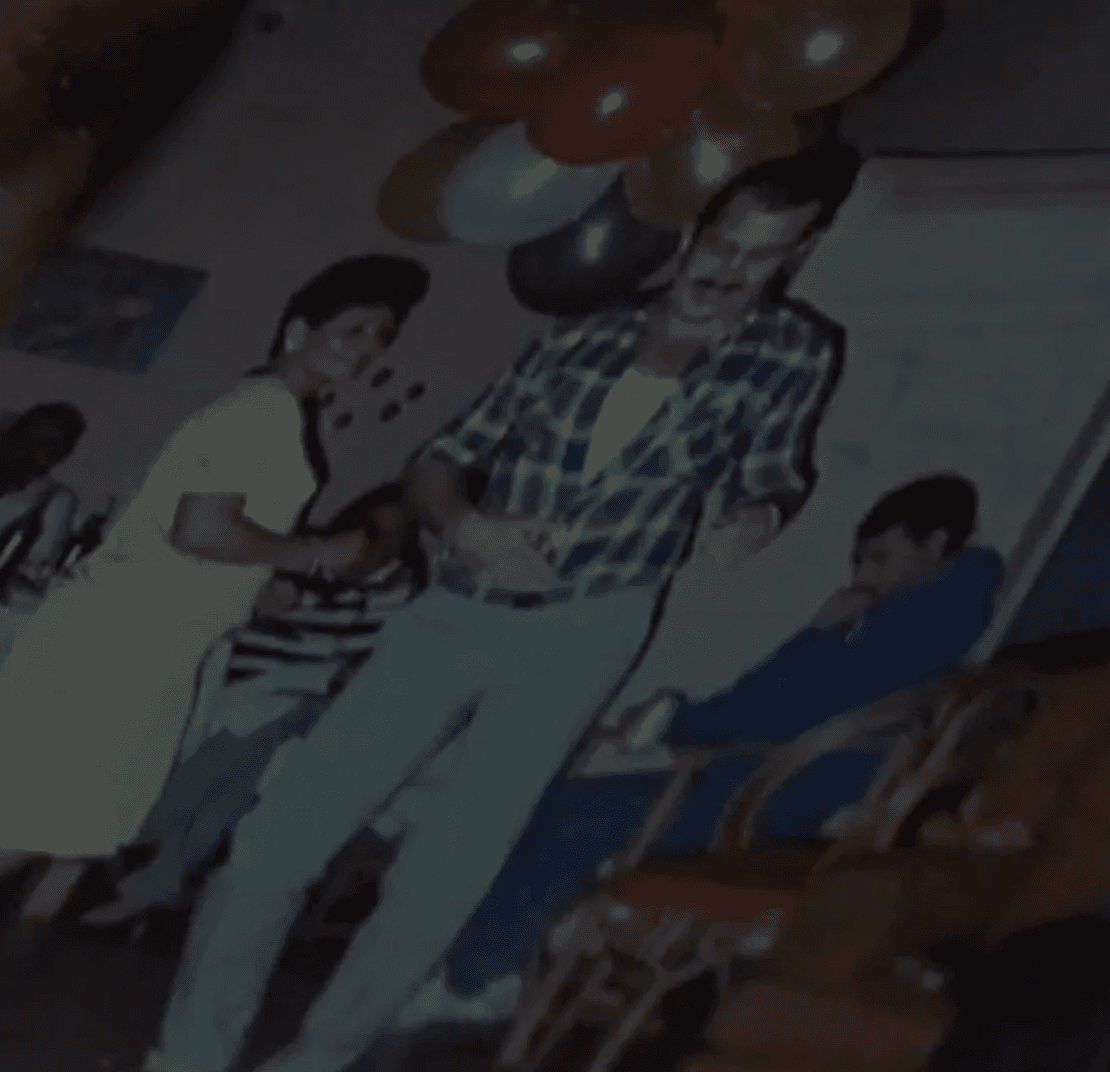
This resignification of the material may never be as visible and explicit as in the sequence Costa includes toward the end of the film. In this scene, the director incorporates an archival video of her grandmother’s eightieth birthday celebration. In the footage, the entire family is gathered, with colorful balloons decorating the space and a large cake placed at the center of the table. Everyone sings “Happy Birthday,” with the matriarch in the foreground, surrounded by Pedro and the children, while Rodolfo stands slightly further back (Figure 16).
At first glance, the scene appears to depict a family united in harmony. However, Costa intervenes in this image of traditional cohesion through several mechanisms. First, its inclusion in the film, after having traced Rodolfo’s history and experience of repression, alters its meaning: what might previously have seemed like an innocuous image now reveals an underlying tension. Moreover, formally, the filmmaker manipulates the material through a digital zoom onto Rodolfo’s figure and a slowing down of the image that extends his presence within the frame, making his marginalization within the family scene explicit.
But there is another subtle detail that the director emphasizes: the arrangement of bodies within the frame. Costa’s voice-over points to an apparently normalized order within the image: “Dad was singing in the front row and Rodolfo behind him,” almost like an implicit rule that organizes the family hierarchy. The image confirms this structure, with Rodolfo displaced into the background, removed from the center of attention. However, through Costa’s resignification, this logic is challenged. By slowing down the image and centering attention on Rodolfo, the director subverts the imposed order, symbolically placing him in the foreground. What was once a diffuse and relegated presence becomes sharp, almost as if the narrative itself could correct the opacity that surrounded him in life.
In this way, the home video ceases to be a simple domestic record and becomes evidence of the ideological fractures within the family, revealing how traditional values of unity and respect for elders coexist with the silencing and exclusion of those who do not fit within normative frameworks.
Although Costa encounters an archive marked by pain, denial, and shame, her work as a filmmaker consists in transforming that archive into a space of resistance. The filmmaker not only documents Rodolfo’s exclusion but, in doing so, grants him a renewed presence, restoring him to a place within both family history and public memory. Regina Kunzel expresses a similar sentiment in her intervention at the roundtable Queering Archives (2015), where she poses a fundamental dilemma: “If I don’t mine this archive for instances of queer resistance and redemptive counternarratives, I’m forced to reckon with its arguably more overarching story: of remorse, self-loathing, shame, humiliation, and pain” (p. 215).
Thus, family memory becomes Costa’s battleground, through which she not only challenges the silence imposed by her father and her surroundings, but also generates an alternative form of queer subjectivation: one that does not originate in direct testimony, but in the loving reconstruction of what was omitted. As Cvetkovich argues, archives produce situated knowledges, discourses, and subjectivities, configuring different regimes of what can be archived. In 108: Cuchillo de Palo, the archive Costa constructs is not only a recovery of the past, but an act of resistance against exclusion and forgetting.
All Rights Reserved © 2025